
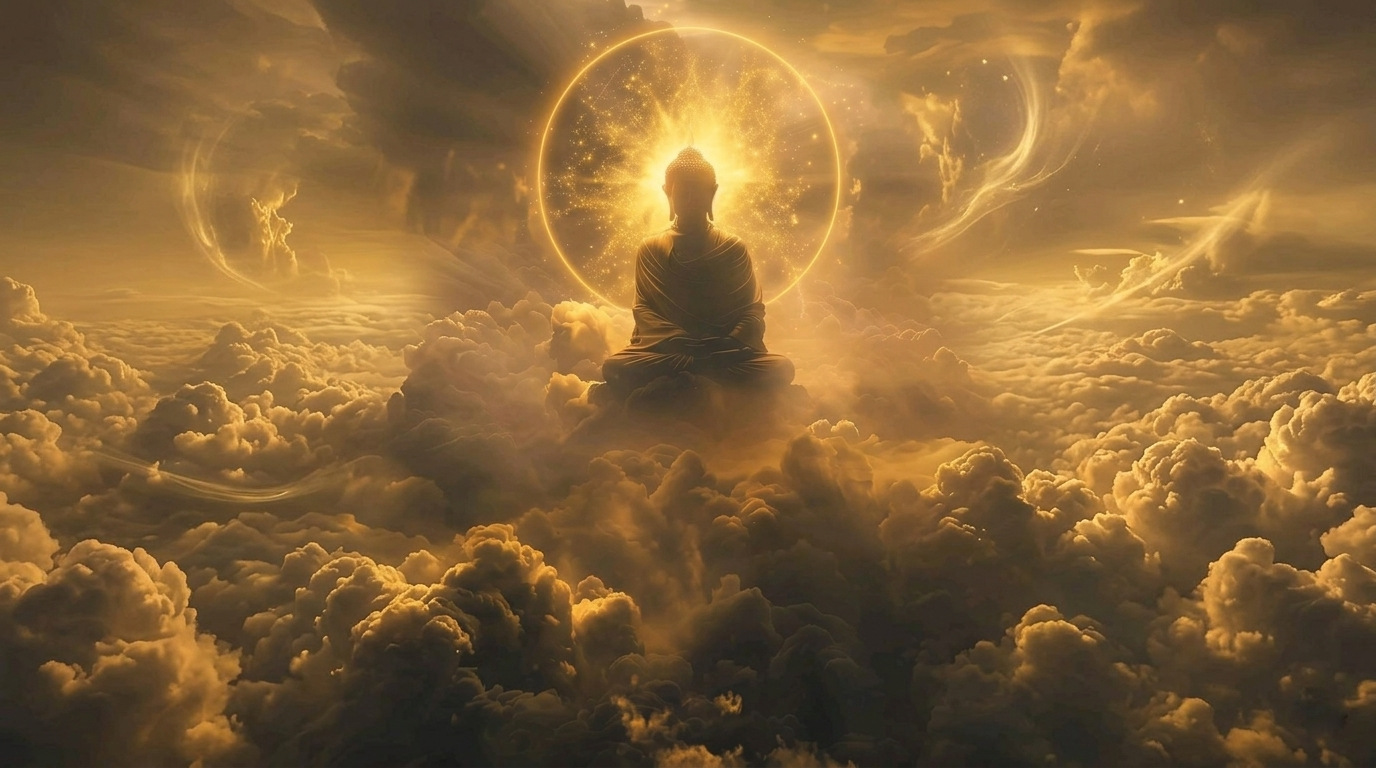
Discover the timeless wisdom of the Buddha to understand the true nature of the mind and find the path to eternal liberation. By realizing the emptiness of all things, we can transform our suffering into a peace that never fades.
The Four Noble Truths – Understanding Life’s Suffering and the Way to Freedom
The Four Noble Truths are the core teachings that the Buddha first shared after his enlightenment. They explain the reality of suffering in life and how we can overcome it:
The Truth of Suffering (Dukkha)
Life involves suffering. This includes obvious pain like aging, illness, and death, but also the pain of not getting what we want or losing loved ones. Simply put, suffering is a natural part of human life.
The Truth of the Cause of Suffering (Samudaya)
Suffering comes from attachment and desire—our craving for things to be a certain way or to own things. It’s like thirst in the mind, always wanting more or trying to hold on to what we like.
The Truth of the End of Suffering (Nirodha)
If we let go of attachments and cravings, suffering can end. This state of freedom and peace is called Nirvana—complete liberation from suffering.
The Truth of the Path (Magga)
There is a way to end suffering, known as the Eightfold Path. By following this practical guide, we can reach Nirvana.
What is Dependent Origination (Pratītyasamutpāda)?
A famous Buddhist teaching says:
“Because this exists, that exists; because this ceases, that also ceases.”
This means nothing exists independently—everything depends on other conditions. Our identity, feelings, and experiences arise through many causes and conditions working together.
The Twelve Links of Dependent Origination
Buddhism explains the cycle of life and suffering through 12 connected stages:
| Step | Meaning |
|---|---|
| 1. Ignorance (Avidyā) | Not understanding reality |
| 2. Volitional Actions (Karma) | Intentional deeds |
| 3. Consciousness (Vijñāna) | Awareness, seeds of rebirth |
| 4. Name and Form (Nāmarūpa) | Mind and body |
| 5. Six Senses (Ṣaḍāyatana) | Eyes, ears, nose, tongue, body, mind |
| 6. Contact (Sparśa) | Meeting of senses and objects |
| 7. Feeling (Vedanā) | Sensations (pleasant, unpleasant, neutral) |
| 8. Craving (Tṛṣṇā) | Desire and attachment |
| 9. Clinging (Upādāna) | Grasping, holding on |
| 10. Becoming (Bhava) | Existence and karmic formation |
| 11. Birth (Jāti) | New life |
| 12. Aging and Death (Jarāmaraṇa) | The cycle of suffering continues |
This chain shows how suffering starts from ignorance and continues through rebirth and death.
Key Messages of Dependent Origination
No Fixed Self: There’s no permanent, independent “I.” What we call “self” is just a combination of conditions and changing factors.
Everything Changes: Since conditions change, everything is in constant flux.
Stopping Suffering: If we cut off craving and clinging, the cycle of suffering ends.
Everyday Examples
Fire: A fire needs wood, oxygen, and heat. If any one is missing, the fire stops.
Emotional Pain: Feeling hurt by words happens because of the words, our interpretation, and our pride. Change the conditions, and the reaction changes.
The Three Marks of Existence (Tri-lakṣaṇa)
Impermanence (Anicca): Everything changes.
No-self (Anattā): No permanent self exists.
Nirvana (Nibbāna): The peaceful state when suffering ends.
The Eightfold Path – A Practical Guide to End Suffering
The path isn’t just meditation; it’s a way of living with these eight steps:
Right View: Understand the Four Noble Truths.
Right Intention: Think kindly and without attachment.
Right Speech: Speak truthfully and kindly.
Right Action: Act without harming others.
Right Livelihood: Choose a job that does no harm.
Right Effort: Build good habits, reduce bad ones.
Right Mindfulness: Stay aware of the present moment.
Right Concentration: Practice deep meditation to realize truth.
The Five Precepts and Ten Virtues
Five Precepts: Basic ethical rules like not killing, stealing, lying, or using intoxicants.
Ten Virtues: Avoid harmful actions by body, speech, and mind.
Wisdom from the Dhammapada (Sayings of the Buddha)
Let go of attachments like a snake shedding its skin to find freedom.
“Go alone like a rhinoceros horn” means sometimes the path to freedom is walking your own way without clinging to others.
Avoid 12 “doors of destruction” like bad company, laziness, and greed.
True happiness comes from inner purity, wisdom, effort, generosity, and patience, not from outside things.
Live fearless like a lion, free like the wind, and pure like a lotus.
Let go of attachments, walk your own path, practice ethical living and mindfulness, and seek inner peace and freedom.
Understanding the Horizon of Modern Western Buddhism and the Deep Depths of the East
Part 1: The Modern Horizon of Western Buddhism and Its Limitations
Today, the Western understanding of Buddhism is deeply rooted in an early Buddhist framework: the “Cessation of Suffering.” The common impression that Western Buddhism is heavily focused only on ancient, foundational texts is historically accurate.
The Nature of Historical Contact: When the West began studying Buddhism academically in the 19th and 20th centuries, the texts that seemed most rational and logical to modern minds were the early Pali literature, such as the Agamas and Nikayas. For Westerners fatigued by rigid Christian dogmas and rituals, the complex mythologies, cosmic architectures, and religious ceremonies of later movements like Mahayana or Esoteric Buddhism held little appeal.
The Filter of “Secular Buddhism”: Western societies generally embraced Buddhism not as a traditional religion, but as a practical tool for psychology, philosophy, and neuroscience. In this adaptation, supernatural concepts like rebirth, the afterlife, and cosmic protectors were often set aside. Instead, the focus shifted to practical, everyday techniques—primarily meditation—to reduce stress.
The Commercialization of Mindfulness: The mindfulness movement championed by Silicon Valley and Western medicine has largely stripped away Buddhism’s ultimate spiritual goal (liberation) and reframed it as a tool for personal well-being and productivity.
Consequently, rather than fully absorbing the vast, 2,500-year philosophical and existential evolution developed in Asia, Western Buddhism remains largely focused on early texts as a practical tool for personal psychological healing.
Part 2: The Depth of Traditional Practice and the Global Streams of Buddhism
The ultimate goal of Buddhism is undeniably Nirvana and Liberation. In the early scriptures, the Buddha consistently refused to answer purely speculative, metaphysical questions—such as whether the universe is eternal or what happens after death. He practiced what is known as Avyakata (noble silence), believing that linguistic debates do nothing to solve immediate human suffering or lead to true freedom.
“The fading away of greed, the fading away of anger, the fading away of delusion: this is called Nirvana.” > — The Samyutta Nikaya (Early Scripture)
Buddhism has always aimed at breaking free from the fundamental attachments of human existence. Over 2,500 years, it has branched into various schools adapted to different cultures. Among these, Korean Buddhism preserves a uniquely intense tradition of meditative cultivation.
The Seed of Liberation: The Phenomenon of Sari (Sacred Relics)
One of the most striking physical phenomena showcasing the depth of Eastern practice is Sari. Derived from the Sanskrit word sarīra, these are mysterious, colorful, pearl-like crystal stones found among the ashes after a deeply realized master is cremated.
In Eastern energetic and meditative traditions, the formation of these relics is seen as the physical result of extreme mental concentration and internal energy circulation. When a practitioner focuses their vital energy in the lower abdomen (the dajeon or core), a powerful internal heat is generated. In deep cultivation, the vital art lies in controlling the intensity and timing of this inner fire:
The Gentle Fire (Mun-hwa): By completely emptying the mind and breathing softly, a gentle, warm energy rises, opening the body’s energy pathways. As this energy circulates through the spine to the brain, it brings absolute stillness.
The Fierce Fire (Mu-hwa): This involves a dynamic, forceful direction of internal energy to clear stubborn blockages in the body’s circulation.
By perfectly balancing these internal fires day and night without interruption, practitioners transmute their physical and mental energy into a condensed crystallization—the “seed of liberation.”
A modern example that astounded the public was the Korean Master Seongcheol (1912–1993). Famous for his fierce dedication, he spent eight years practicing Jangjwa-bulwa—never once lying down to sleep, meditating upright through the night. When he passed away and was cremated, over 110 pristine pearl-like Sari relics were found in his ashes, leaving a tangible testament to a lifetime of uncompromising practice.
Part 3: Skillful Means — How Buddhism Shaped Itself for Different Minds
The division of Buddhism into various sects and practices is not accidental. The Buddha anticipated a future era when spiritual capacity would decline and human distractions would intensify. To prepare for this, he utilized “Skillful Means” (Upaya)—tailoring his teachings to the specific spiritual capacity, personality, and cultural background of his listeners, much like a doctor prescribing different medicines for different illnesses.
Early (Theravada) Buddhism: For the Rational and Independent Seeker
The Mindset: Best suited for highly analytical individuals who value self-reliance and psychological logic.
The Method: Stripping away mysticism and ritual, this path focuses on strict ethical discipline and Vipassana (insight) meditation to observe the mind objectively. The goal is to personally achieve the state of an Arhat (a liberated being). Today, this original blueprint is preserved heavily in the Southern Buddhist traditions of countries like Thailand and Sri Lanka.
Mahayana Buddhism: For the Compassionate Altruist
The Mindset: Designed for those who feel deeply connected to society and find it impossible to seek personal peace while others suffer.
The Method: This school introduces the Bodhisattva ideal—an enlightened being who vows to postpone their own final rest until all living beings are saved. It emphasizes social action, compassion, and the profound philosophy of Sunyata (Emptiness/Interconnectedness).
Vajrayana (Esoteric/Tibetan) Buddhism: For the Intense and Strong-Willed
The Mindset: For individuals seeking rapid, urgent enlightenment within a single lifetime, unwilling to wait through cycles of rebirth.
The Method: Instead of gradual progression, it utilizes advanced, intense methods: complex visualization of mandalas, sacred chants (mantras), and the direct control of subtle physical energies (chakras). This is the core of Tibetan Buddhism.
Zen (Seon) Buddhism: For the Intuitive and Pragmatic
The Mindset: Tailored for East Asian cultures that value direct, spontaneous insight over heavy academic theory.
The Method: It champions Satori or Don-o (sudden enlightenment) through Gong’an/Koan practice (meditating on paradoxical riddles to break rational thought). It elevates daily labor into meditation, living by the rule: “A day without work is a day without food.”
Pure Land & Engaged Buddhism: For the Everyman in a Busy World
The Mindset: For everyday citizens who lack the time or luxury to spend decades in isolated mountain monasteries.
The Method: It simplifies practice to extreme focus. Practices like chanting a single Buddha’s name (Nembutsu) or “just sitting” (Shikantaza) allow ordinary people to find spiritual anchoring amidst regular family and professional lives, a style highly prevalent in Japan.
Part 4: The Endless Wheel of Rebirth and Spiritual Blindness
The Scale of Time: Cosmic Eons (Kalpas)
In Buddhist cosmology, time is measured in Kalpas (cosmic eons)—units so vast they defy human imagination. One classic analogy describes a solid granite mountain, 9 miles high and 9 miles wide. Once every 100 years, a celestial being flies past and gently strokes the rock with a soft silk cloth. The time it takes for that mountain to be completely worn away to nothingness is just one Kalpa. Modern physics might compare it to the multi-billion-year life cycle of a planet or solar system.
The Buddha used this staggering scale to illustrate the weight of human existence:
“The ocean of tears you have shed while wandering through this long cycle of rebirth—losing parents, losing children, losing those you love—is greater than the water in all the four vast oceans combined.”
He added that over these unfathomable eons, it is nearly impossible to meet another living being who has not, at some point in time, been your mother, father, brother, or dearest friend.
Neurological Resets and Spiritual Ignorance
If we have lived for so long, why do we remember nothing of our past lives and continue to repeat the same painful mistakes? Buddhism attributes this to Avidya (Spiritual Ignorance/Blindness). From a modern neuroscientific perspective, we can think of this as a neurological reset at birth.
The moment we receive a new physical body, the memory circuits of our past are severed. Born with a blank slate, human beings learn the rules of survival from scratch. In the struggle to survive, the “Three Poisons”—greed, anger, and delusion—are automatically triggered, locking us into a cycle of generating new reactive habits (karma).
Modern medicine provides an interesting analogy through Electroconvulsive Therapy (ECT). When a strong electrical stimulus is safely applied to a patient’s brain:
Memory Disruptions: The electrical current disrupts synaptic connections, temporarily erasing recent or short-term memories.
Emotional Shifts: By forcing a “system reboot” of overactive neural circuits, neurochemicals like serotonin and dopamine reset. Severe, deep-seated depression can vanish instantly, making the patient appear like a completely different, calm person to outside observers.
This raises both a scientific and philosophical question: If a simple physical disruption can erase our memories and entirely alter our immediate personality, why do we stake our lives on temporary emotions and identities that have no permanent substance?
Neuroscientifically, an emotion is a fleeting chemical cocktail in the brain. Yet, caught in the illusion of the ego, we obsessively claim “my anger,” “my trauma,” or “my desire.” Buddhism views this as a failure to see reality as it is. Because humans constantly overreact to these passing biological shadows, they tether themselves to the laws of cause and effect, spinning endlessly on a wheel of their own making.
Why Liberation is the Ultimate Destination
In Buddhism, the cycle of rebirth is called Dukkha (unsatisfactoriness/suffering). This does not mean that life is entirely miserable or devoid of joy. Rather, it means that life is fundamentally beyond our ultimate control (Anatta) and constantly changing (Anicca). There is no permanent harbor.
Even if one is born as a wealthy king or a celebrity in this life, that reality resets at death. We face the reality of aging, sickness, and death all over again, forced to re-learn how to navigate the world from scratch. This infinite loop of starting over, blinded by a lack of awareness, is the truest definition of suffering. Therefore, the ultimate goal of Buddhism must be Liberation—completely stepping off this repetitive wheel.
While Western Buddhism provides wonderful, essential tools for introductory stress relief and psychological healing, traditional Asian lineages—such as the cohesive “Tong-Bulgyo” (Unified Buddhism) tradition of Korea—offer a holistic map. By fusing the strict mental training of early Buddhism, the social compassion of Mahayana, and the direct intuition of Zen, it serves as a lighthouse. It reminds us that beyond simply lowering our daily stress, the ultimate promise of the practice is to shatter fundamental ignorance and step into absolute freedom.
Vocabulary Guide: Key Buddhist Concepts
Nikayas / Agamas: The earliest recorded collections of the Buddha’s discourses, written in ancient languages (Pali and Sanskrit). They focus primarily on basic psychology, ethics, and mindfulness.
Nirvana / Liberation: The ultimate spiritual goal in Buddhism. It literally means “extinguishing” or “blowing out” the fires of greed, hatred, and delusion, resulting in perfect peace and freedom from involuntary rebirth.
Avyakata (Noble Silence): The Buddha’s practice of refusing to answer unanswerable metaphysical questions (e.g., “How did the universe begin?”). He believed debating things beyond human experience diverted energy away from solving actual suffering.
Sari: Sacred, pearl-like crystals or relics found in the ashes of highly realized Buddhist masters after cremation. In Eastern culture, they are viewed as physical evidence of a lifetime of intense mental and spiritual purification.
Skillful Means (Upaya): A core Buddhist concept meaning adaptability or flexibility. It is the idea that a teacher should modify the style, language, and complexity of a truth to match the specific level and capability of the listener.
Arhat: A person who has achieved individual enlightenment and liberation from suffering by following the Buddha’s teachings.
Mahayana: One of the main branches of Buddhism (dominant in China, Korea, and Japan). It emphasizes universal compassion and the salvation of all beings, rather than just individual liberation.
Bodhisattva: An enlightened being in the Mahayana tradition who voluntarily chooses to delay entering final Nirvana out of deep compassion, remaining in the world to help guide and save others.
Sunyata (Emptiness): A profound Buddhist philosophy stating that no person or object has a separate, permanent, independent soul or entity. Instead, everything exists in a web of deep interconnectedness and constant change.
Vajrayana: The esoteric or tantric branch of Buddhism (prominent in Tibet). It uses advanced energetic practices, visualizations, and rituals to fast-track the path to enlightenment.
Mantra / Mandala: Mantras are sacred sounds, words, or phrases chanted repeatedly as a focus for meditation. Mandalas are complex, geometric spiritual artworks representing the universe, used for deep visual concentration.
Gong’an / Koan: A paradoxical riddle or statement used in Zen meditation (e.g., “What is the sound of one hand clapping?”) designed to exhaust the logical mind and force a direct, intuitive breakthrough.
Dukkha: Often translated as “suffering,” it more accurately means unsatisfactoriness, friction, or instability. It refers to the underlying anxiety of life caused by the fact that pleasant things are temporary and out of our ultimate control.
Anicca & Anatta: Anicca means impermanence (everything changes). Anatta means non-self (there is no rigid, unchangeable “you”). Together with Dukkha, these form the core pillars of how Buddhism views reality.
Avidya: Spiritual ignorance or blindness. It is the fundamental inability to see the true nature of reality, which causes humans to mistake temporary illusions for permanent happiness.
Below is a curated list of essential resources for exploring the Buddha’s original teachings.
A perfect thematic anthology that organizes the Buddha’s vast teachings into a clear, step-by-step map for all readers.
A concise and beautiful collection of verses focusing on the heart of practical meditation and daily mindfulness.
A world-renowned classic that provides a crystal-clear explanation of the Four Noble Truths and the fundamental Buddhist path.